01Many terminals
One operating picture
Portfolio, project boards, active workspaces, and a shared needs-you inbox replace console babysitting.
Open source · self-hosted · MIT licensed
MAIster runs versioned software-delivery Flows across your repositories. Agents work in isolated worktrees, humans enter at declared gates, and evidence decides what can ship.
curl -fsSL https://imaister.dev/quickstart.sh | bashPostgres in Docker, two host processes, first governed run in about ten minutes. Follow the quickstart → · Read the script ↗
The operating gap
The hard part is no longer producing code. It is keeping parallel agent work repeatable, reviewable, constrained, and connected to the way software actually ships.
Portfolio, project boards, active workspaces, and a shared needs-you inbox replace console babysitting.
Flows ship as trusted, versioned packages. Every run records the exact package, engine, and runner it used.
Typed artifacts and blocking gates expose what passed, failed, went stale, or still needs a decision.
Each session receives only its declared skills, MCPs, tools, environment, and restrictions at the ACP seam.
Product tour
MAIster is designed for a technical owner or small engineering team operating multiple private repositories and coding agents on its own infrastructure. Web for people, REST and MCP for personal agents.
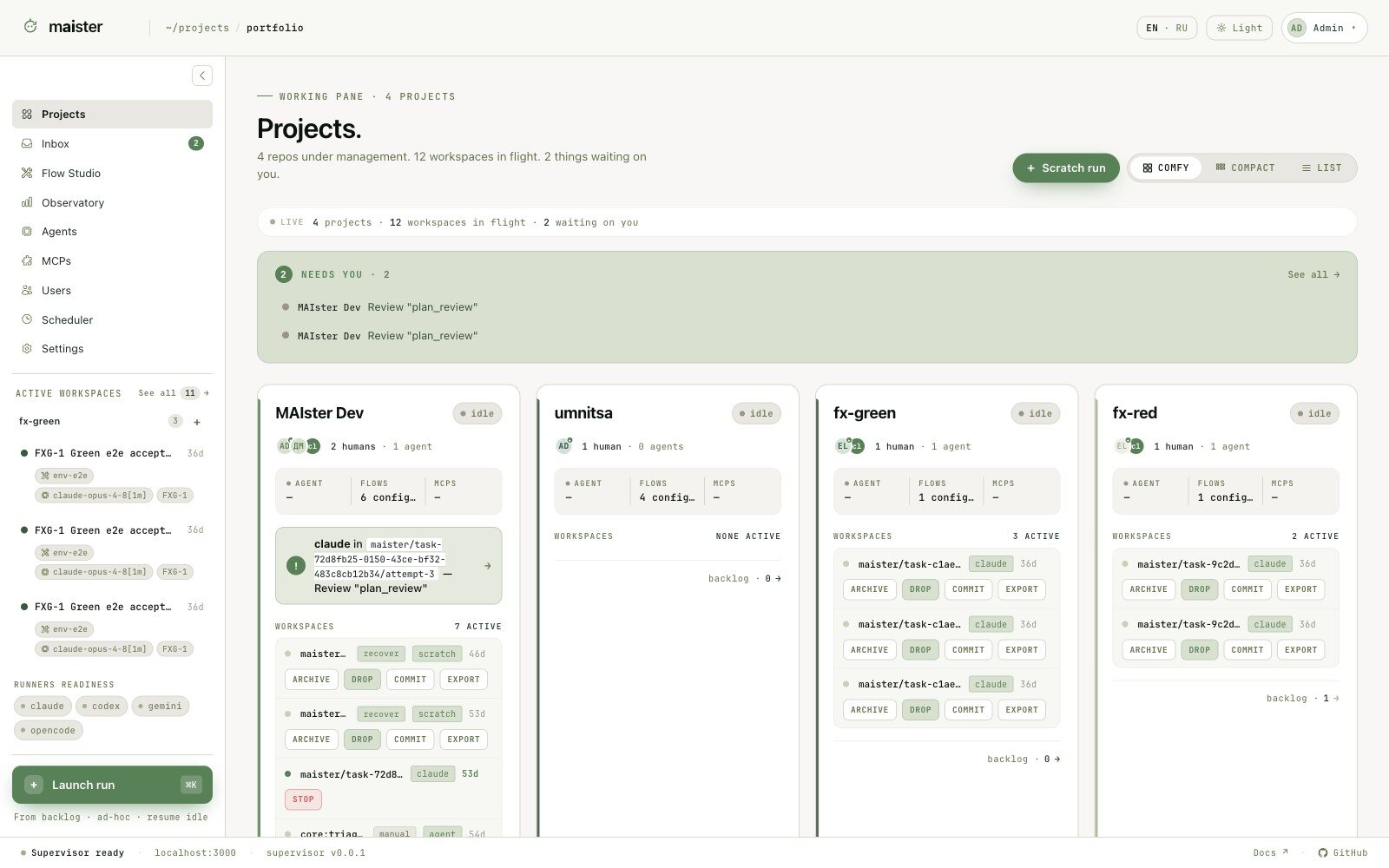
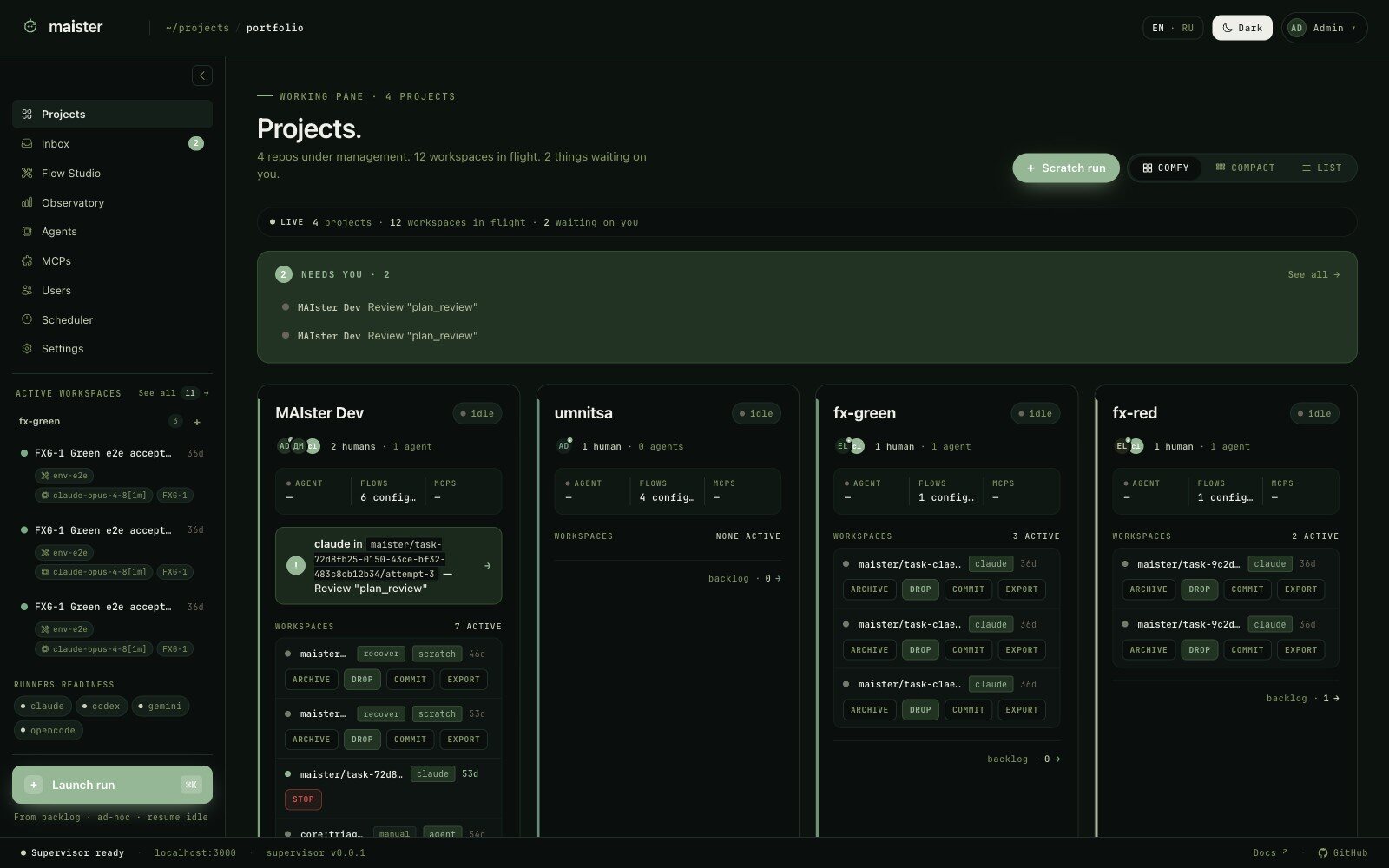
Projects, active workspaces, runner readiness, and the needs-you count stay visible without opening a single terminal.
The delivery spine
MAIster is not another coding agent and not a generic workflow canvas. It is the execution layer that gives your existing agents a repeatable path through real software delivery.
Every handoff leaves a ledger entry. Every promotion crosses the same readiness choke point.
The product, not just the runner
The deterministic spine stays small: ownership, state, evidence, budgets, and promotion. Around it, MAIster adds shared and private memory, artifact authoring and improvement, comparison, and the operating surfaces required for sustained agent work.
Install, inspect, trust, enable, upgrade, roll back, and keep active runs pinned to their original revision.
A Flow can bring up an isolated application stack and its dependencies, run integration and E2E suites, and keep reports and logs as required evidence. Together with AI judgments, external checks, and human review, that evidence blocks or clears promotion.
Permissions, forms, plan review, manual takeover, rework, and conflict resolution appear when the Flow says they matter.
Run trees, package agents, triggers, and consensus share budgets and audit instead of creating an invisible swarm.
Materialize only the declared skills, MCP servers, tools, environment, and guardrails for each ACP session.
Run one task with different Flow revisions, coding agents, and models. Compare evidence and AI-judge scores with elapsed time, token usage, and the calculated cost of every Run.
The path to agentization
MAIster separates agentization into four stages. Each stage has its own durable object, control boundary, and observable handoff. Move right when the previous level becomes repeatable and produces evidence.
Read about the four stages ↗Flow packages
Flows, skills, agents, and MCP templates ship together in trusted packages, installed from git and pinned by tag. The public catalog already carries the methods teams use with coding agents, so a Flow written for one project moves to the next installation unchanged.
aifPlan, implement, review, evolve: five governed flows with their skills and agents.
superpowersFour typed flows with structured design, verification, and review handoffs.
spec-kitSpec-driven development from GitHub as governed flows.
openspecSpec-driven flows with typed change and review handoffs.
bmadPlanning, build, test architecture, and creative flows with platform agents.
pstackEvidence-first engineering with typed result profiles and an evaluation method.
env-e2eAn ephemeral docker-compose stack plus Playwright E2E as readiness evidence.
coreTriage, Brain Improver, the evaluation judge, and Java, React, and Postgres skill packs.
Compare
Boards give you a worktree per agent and a diff to read. Runners give you unattended runs and a pull request to check. MAIster gives your existing agents a repeatable, evidence-gated path through real delivery.
| Kanban orchestrators | Autonomous runners | MAIster | |
|---|---|---|---|
| Process | A board and a worktree per agent | An issue tracker as the queue | A versioned Flow package pinned to every Run |
| Proof before merge | Read the diff | Check the pull request | Typed evidence gates, readiness, and human review |
| Human checkpoints | Approve when the CLI asks | Watch the PR | Declared in the Flow: permission, form, review, escalation, one inbox |
| Budgets | None | Per agent | Per Run, node, and Run tree: warn → escalate → terminate |
| Capabilities | Whatever the CLI has | Whatever the CLI has | Only the declared skills, MCPs, tools, and environment per session |
| Agents | Several CLIs side by side | Usually one vendor | Claude, Codex, Gemini, OpenCode, MiMo through ACP, including subscriptions |
| Compare variants | By hand | By hand | Evaluation Lab: one task, several Flows, agents, and models |
| Where it runs | Your laptop | Their cloud or yours | Your host, MIT |
Kanban orchestrators: Vibe Kanban, Superset, Paseo, and similar tools. Autonomous runners: Symphony, Paperclip, and similar. Categories, not verdicts: several of them are good at what they do.
Built in the open
MAIster is MIT licensed. Follow the implementation, architecture decisions, and delivery history directly in the repository. Feature requests, bug reports, and pull requests are welcome.
Open on GitHub ↗Services
MAIster is free and MIT licensed. If you want it in production without spending your own weeks on it, the maintainer works with teams directly.
Where your team's agent work loses time and quality, and which process to automate first. You get a written report and two Flow packages for your own process.
MAIster on your host, connected to your git provider and CI. Flows for bugfix, feature, review, docs, and dependencies; gates, budgets, and roles; a trained team; thirty days of support.
Upgrades, new packages, incident review, and priority in the roadmap.
Replies within one working day.
Questions
No. Repositories, prompts, diffs, secrets, and artifact bodies stay inside your infrastructure. The control plane and execution host remain under your administration. MAIster ships no analytics and no telemetry; the only outbound traffic goes to the model providers, git remotes, and MCP servers you configure.
Claude Code, Codex, Gemini CLI, OpenCode, and MiMo run through the Agent Client Protocol. MAIster starts the CLIs with the authentication configured on the execution host, including supported subscription-backed sessions; API providers such as Anthropic, OpenAI, and OpenRouter stay in the same runner catalog.
Yes. Spec Kit, OpenSpec, BMAD, Superpowers, and AI Factory already ship as packages, and any git repository with a flow.yaml can become one. Flow Studio edits packaged Flows visually and forks them into local versions.
Register a repository, create a task, pick a Flow, launch. The Run gets an isolated worktree, a recorded Flow revision, and an observable outcome. Promotion stays a separate, explicit action.
The web control plane owns product state. A separate execution-host supervisor owns ACP sessions and agent processes. Postgres keeps the durable ledger; isolated git worktrees hold code and evidence payloads. Today both processes share one trusted host; multi-host placement is on the roadmap.
MAIster is MIT licensed; you pay only your model providers. Run Inspector shows input, output, cache-read, and cache-creation tokens beside active and wall-clock time, and budgets warn, escalate, and terminate. Currency pricing is on the roadmap.
Start with one real process
Run MAIster on your own host, connect a private repository, and qualify the first repeatable delivery process with evidence and review built in.